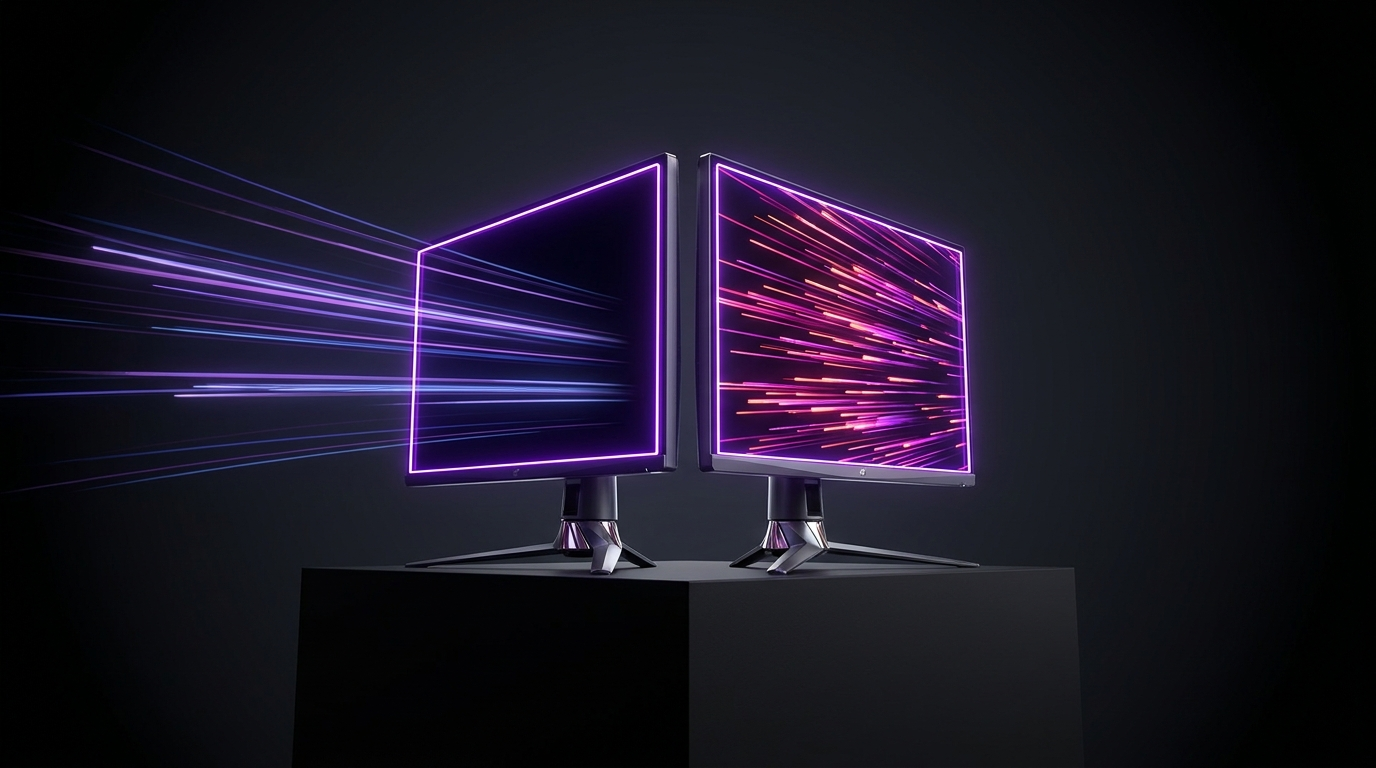
144Hz vs 240Hz monitors: when the upgrade is truly worth it
On watch, the difference between seeing and seeing in time is everything. The monitor is where that difference lives — and where marketing plants its finest traps.
Let's establish the facts before the verdict.
The jump everyone feels
From 60Hz to 144Hz there is no debate: it's the biggest sensory transformation a setup can receive. The cursor glides, the camera pans without smearing, the game seems to respond before you ask. Any player — casual, competitive, veteran, rookie — notices within ten seconds. If you're still at 60Hz with hardware for more, stop reading and fix that: no other upgrade delivers so much for so little.
The jump few can use
From 144Hz to 240Hz, the physics remains real — fresher frames, less blur, newer visual information — but returns diminish. In blind tests, high-level competitive players distinguish and benefit; average players barely notice and improve even less. The honest question: are your matches decided by margins that 4 milliseconds resolve? If you compete in FPS with serious dedication, yes, 240Hz is a legitimate tool. If you play a bit of everything, the money yields more in a better panel, higher resolution or the graphics card itself — because refresh rate without matching FPS is an empty promise: a 240Hz monitor running a game at 110 frames is an expensive 110Hz.
The contract's fine print
Hz isn't the case's only number. Real response time (not the box's) separates clean panels from smears; IPS delivers colors and angles, VA deep contrast with ghosting risk, TN raw speed with dated visuals — and OLEDs, ever more accessible, humiliate them all in response and contrast, charging in price and static-image care. Adaptive sync is non-negotiable at any tier. And check the forgotten obvious: the right cable and port for the promised rate.
The verdict
144Hz (or 165Hz, its natural successor) is the serious player's new floor — buy without fear. 240Hz is specialist equipment: worth it for those who live on razor margins. Above that, 360Hz and beyond, we're in athlete-and-sponsorship territory.
Buy the monitor for the player you are, not for the one the ad says you'd become.
Choose by your profile
| Profile | Rate | Panel | Resolution/size |
|---|---|---|---|
| Casual / story games | 60–100 Hz | IPS or VA | 1080p 24" or 1440p 27" |
| Dedicated competitive | 240 Hz+ | Fast IPS | 1080p 24.5" |
| Mixed (most people) | 144–180 Hz | IPS | 1080p 24" or 1440p 27" |
| Immersion / open world | 100–165 Hz | Curved VA or IPS | 1440p 27"+ or ultrawide |
— From the shadows, DKG.
Quick answers
Is 60Hz to 144Hz really that big?
It's the largest sensory difference in monitors — noticeable in seconds even for non-gamers. From 144 to 240, only dedicated competitors extract value.
IPS or VA?
IPS for colors, angles and consistent response; VA for deep contrast in dark games and movies, accepting some ghosting. For competitive play, fast IPS.
24 or 27 inches?
At 1080p, 24" (27" at 1080p shows too much pixel). At 1440p, 27" is the perfect match of sharpness and usable area.
Do I need DisplayPort?
For rates above 144Hz, usually yes — with a cable certified for the required bandwidth. Recent HDMI also works, but check the port version on BOTH ends.
🦇 The Knight's Recommended Arsenal
As an affiliate, I may earn a commission from purchases made through the links below — at no extra cost to you. Learn more.
AOC 27G4
The gold standard of value.
ASUS TUF VG259QM
For those who actually compete.
AOC Q27G3XMN
Sharpness and fluidity in the same contract.
HUANUO Monitor Arm
Perfect position, free desk.
Cable Matters DisplayPort Cable
Full refresh depends on the right cable.

The Knight
Editor, Dark Knight Gaming
DKG's editorial vigilante. Covers gaming culture, hardware and the industry from the city's shadows — with method, skepticism and zero clickbait.
About the project →Related
Gaming headsets: what really matters (and what's just marketing)
The market wants to sell you LEDs and a "7.1 surround" sticker. I want you to hear the enemy's footsteps before he thinks about taking the second one. Let's separate signal from noise.
How to make your setup last 5 years
The machine doesn't die of old age — it dies of neglect and wrong upgrades. Maintenance and strategy for half a decade of loyal service.
Controller vs mouse and keyboard: the war nobody wins
Decades of flame war, and the answer remains the same: it depends on the weapon, it depends on the mission. An honest dossier on the hobby's oldest rivalry.